10 Mindset Shifts Every Designer Needs in the AI Era
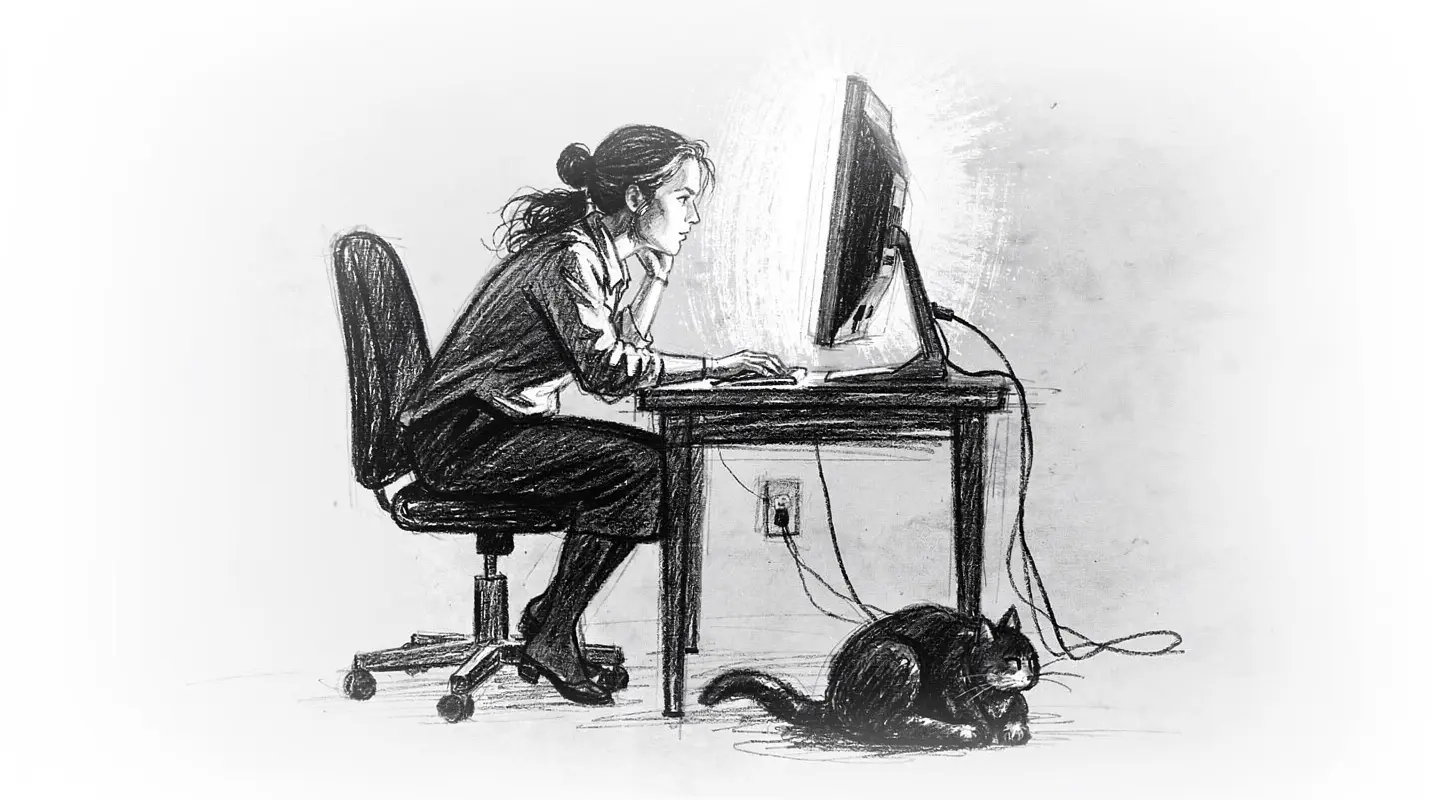
I remember my very first day as a professional designer. My coworker, a video editor, asked me to make him an image of a car. I think it was a 2007 Toyota Camry. “Make sure it has an alpha channel,” he said. Sure, I told him. No problem.
Big problem. I had no idea what an alpha channel was.
It was my first day. I was a junior designer, working for a local marketing agency whose primary business was making car dealership commercials to punish the senses and test one’s sanity. I’d recently pivoted from a career as an audio engineer & composer. I was in a lofted space with a few other people, but I was the only designer in the room.
Two hours and about seven or eight failed attempts later, the video editor had to help me navigate the menus in Photoshop to get what he wanted. Over my shoulder, I could hear his clipped tone of voice. He was absolutely holding back.
He wasn’t used to working with morons.
I’d be willing to bet he poured himself a stiff drink and prayed for death that night, knowing he had to come back into the office tomorrow and work with a guy who didn’t know how to prepare an image with transparency.
Meanwhile, back in my apartment later that evening, I knew I had my work cut out for me. I knew I needed to roll up my sleeves and dive all the way into this thing. And I did.
Today we designers are facing another uncomfortable shift. A reality check, but this time it’s global. The natural progression of technology has gotten us to a point where machines can do a lot of the rote, tedious things we’ve always had to take a long time to do, relatively quickly.
It’s true, we’re all having little mini freakouts on the regular. You’ve probably noticed.
I believe we’re still smack-dab in the very first phase of the cataclysm, and there are miles to go before we emerge from it into whatever comes next. But having had the unique perspective of seeing the birth of the internet and working as a professional through all the major sea-changes in computing, design, and development, there are some things I’ve learned that I want to encourage you with.
These aren’t laws of the universe, or anything that heavy. They span everything from how you think about your tools to how you think about yourself. They’re a set of principles and perspectives that I’ve learned to implicitly trust, and that continue to enrich my own experience and keep me energized through all the ups and downs that will, I promise you, continue to come along.
1. Loosen your grip on the status quo
Often we forget that status quo just means “what’s happening now.” The fact is, we are always, always in a state of change. We refer to the status quo because these phases of industry, taste, or execution span certain general lengths of time. But you aren’t in control of that, and often the tastemakers of tomorrow are the ones breaking the rules of today.
Notice I didn’t say “let go completely” of status quo. That’s important. You have to know how the world works today, to have context into the choices you make.
2. Taste means nothing without passion
We gravitate towards people who care about their work. Interview ten people with the same skill set, and the ones that stand out to you will be the ones who seem to care the most. They’re the ones who won’t stop caring in the middle of a project, or near the end when it gets harder for creatives to stay interested.
We talk a lot now about taste, as a moat or safeguard against the invasion of AI. The truth is, AI will capture much of the taste market as well. But it can’t capture your passion.
That’s just yours.
3. The rules still matter
Symmetry, spacing, optical flow, UI density, readability, accessibility, typography, color theory, and all the fun things that make up the magic of design still matter just as much as ever.
The joy of our career path is the fact that not everyone cares about that stuff as much as we do. But they react just as intensely to poor implementation. We have competitive advantage in the marketplace because we know, we care, and we like doing a job that most people don’t.
But there are still rules, and you can still wield them creatively.
4. Creativity has never existed in a vacuum
Don’t despair over the influx of AI. It isn’t “erasing design jobs.” It is allowing more people to play with their own creativity than ever before. There will be many people who pursue a career in design because AI allowed them to play in a sandbox they never felt welcome in before.
None of us dream up these things we make on our own. I don’t care if you got a vision in the middle of the night—whatever you came up with is a result of your life, experiences, and interactions with the world around you. We are all passengers, and we all hit the ground running on day one.
Treat creativity like a visitor, not like a personality trait. Be open, stay open, and have no fear.
5. Don’t be afraid of new tools
These new gizmos we’re all playing with right now are amazing. But they won’t be in ten years. Some of you reading this right now know what the sound of a modem connecting to the internet sounded like. That was amazing too, at the time. MySpace, Instant Messenger, Photoshop, Sketch, Figma, et al. They always come, they blow our minds, and we get used to them.
Remember when everyone freaked out about the big IBM computer on season 7 of Mad Men? Don’t be that person.
Observe, think, and engage.
6. Take comfort in your niche tastes
I used to be self-conscious of the repeated patterns in my designs. As the years have gone by, it’s clear there are some things I like: symmetry, containers, typography, practicality, stability. Leftover genetic material from my father, perhaps, who was a civil engineer for 40 years.
You have quirks, preferences, and yes, even peccadilloes that over time will start to become baked into your work. You might sometimes worry that they don’t fit the time you’re in, or that they are interpreted as a weakness.
Don’t. Be uniquely yourself, it’s the only way. It’s also how you develop a voice.
7. Learn how things work
I considered titling this one “learn to develop.” But as of today, even that sounds suddenly archaic. Design, development, etc.—all these labels are in a state of refinement as we negotiate a new relationship with our tools.
But one thing should always be a part of your process: learn how things work. How they actually work. Doesn’t mean you have to become a full-stack anything, it might just mean that you sketch a flow chart with generalities on it, that gives you a deeper understanding of how a particular interface/button/action fits into the overall flow of what you’re making.
Designers who only care about their craft and not about the thing they’re making come off, at best, aloof. At worst, it’s lazy, elitist, and dangerous to the success of the project.
8. Break the bounds of your role
Your role definition is based on a status quo on a previous point in time. Full stop. It isn’t a verdict or a fence to all future endeavors or interests you may develop. Don’t be nervous if you get a niggling feeling that you want to try and, oh, I don’t know, develop a thing.
Do it. Try it. There’s nothing stopping you. Even if all it does is serve to help you understand how things work, then it’s a win.
Plus, exploring other skill sets is an act of bravery and curiosity, and who wouldn’t want teammates like that?
I know I would. And do.
9. Make friends with change
Change is uncomfortable. I hate it, mostly. It forces me to rethink things, change directions, end things, start new things, leave things, and disrupt things. Some people crave it constantly, but I am not that sort.
I’ll never naturally love it. But one thing that’s helped tremendously is to treat it like a friend, not like a virus. It’s a guarantee. It will come periodically, there’s no use pretending it won’t, and no use wasting energy being worried about when it will arrive.
But your attitude toward it and in the midst of it can change your life completely. Jerry Juhl’s masterful script for The Muppet Christmas Carol delivers this gem from Kermit as the ever-steady Bob Cratchit:
“It’s alright, children. Life is full of meetings and partings. That is the way of it.”
10. A curious mind > a worried mind
This is my version of the fight-or-flight response. When faced with new, scary realities, particularly in our area of business, you have a couple choices. You can either lean into curiosity, or worry.
I’m sure you can think of people right now that you know (I know I can) who are leaning hard in one direction. And if you know them well, it probably makes sense. It’s not wrong to be cautious, skeptical, or patient, but—
Take time to judge for yourself the state and health of your curiosity.
Curiosity is what probably got you here in the first place, has preserved and enhanced your professionalism all along the way, and will guide you through hardship, technological upheaval, and whatever chapter comes next.
So, we’re in a new thing.
Great. Now what?
It’s up to us, isn’t it? We talk a lot about agents these days, but not enough about agency. One of the most personal, impactful, and organic things that only you can do is to make determinations about how you choose to operate in our industry.
You get to decide how you approach new things, scary things, and uncomfortable things. One way or another, you’re going to have an impact on the projects you’re a part of. It’s up to you what that impact will feel like to others around you, and how it will make you feel when you shut things down for the day, head home, and live your life.